Segovia with limited mobility: which streets and sights actually work
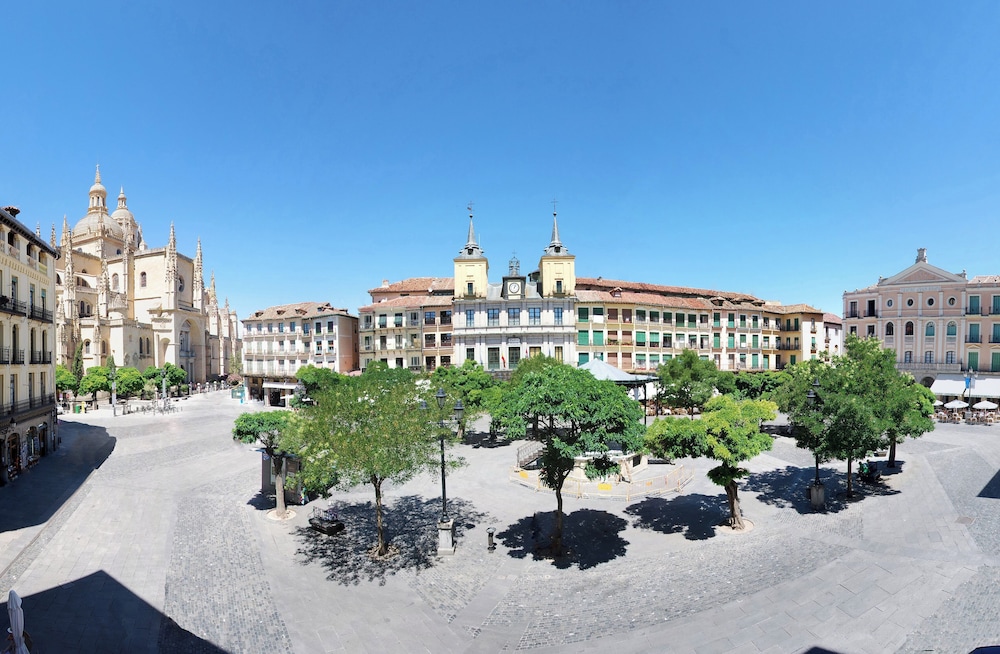
 The level pedestrian stretch of Calle Real leading up from the aqueduct in Segovia
The old town rises about 60 metres from the aqueduct to the Alcázar over roughly one kilometre, and choosing the right approach turns a punishing day into a manageable one.
The shape of the problem
Segovia sits on a rock ridge between two river valleys, with the aqueduct at the low eastern end and the Alcázar on the cliff at the western tip. Everything worth seeing is on that ridge, which means the whole historic visit is a gentle but unrelenting climb one way and a descent the other. The main artery, Calle Real, is a pedestrianised ramp rather than a staircase, and that single fact makes the city far more workable than its reputation suggests. Side streets are another matter: many are steep, several end in steps, and surfaces vary from smooth slabs to rounded river cobbles.
The strategy that works is simple. Go up once, along Calle Real, at your own pace with stops built in, and come down once. Do not zigzag between the ridge and the valley, because every valley detour costs you the whole climb again. If you use a wheelchair or tire easily, consider taking a taxi up to the Alcázar end in the morning and walking the ridge downhill towards the aqueduct, which reverses the gradient in your favour for the entire day.
The gentle route up, and the one to avoid
From the Plaza del Azoguejo, the level square under the aqueduct, take Calle Cervantes and continue into Juan Bravo and Isabel la Católica. That run is paved, pedestrianised, wide enough for two wheelchairs and lined with places to stop for a coffee. The gradient is real but steady, without steps, and it delivers you to the Plaza Mayor and the cathedral. Allow 20 to 30 minutes with rests rather than the ten a guidebook quotes.
The route to avoid is the stone staircase beside the aqueduct that climbs to the Postigo del Consuelo. It is the shortcut everyone photographs and it is steep, narrow, uneven and without a continuous handrail. Anyone with balance issues, a stick or a pushchair should not attempt it in either direction. Likewise, the descents into the Eresma valley towards San Marcos and Vera Cruz are seriously steep, and although the churches down there are lovely, the climb back is the hardest thing in the city. Take a taxi back up if you go down.
Surfaces, cobbles and what a wheelchair meets
The central pedestrian streets are laid with flat slabs and are comfortable enough. Around the cathedral and in the Judería, expect rounded cobbles that vibrate badly in a rigid chair and catch small front castors. Kerbs on the streets outside the walls are mostly dropped at crossings, but not universally, and parked delivery vans block dropped kerbs in the morning. The Plaza Mayor itself is flat and paved, which makes it the natural base for a day: cafés with terraces, the cathedral on one side, and accessible public toilets nearby.
Powered chairs handle the ridge better than manual ones, and anyone pushing a manual chair should expect real effort on the Calle Real ascent. Walking sticks are fine on the slabs and less so on cobbles when wet; the granite polishes to a shine in the rain. Rollators work well on the main run and poorly in the lanes. If you have a choice of visit month, May, June, September and early October give you the best surface conditions and temperatures in the low twenties rather than an August afternoon above 32 degrees.
The monuments, one by one
The aqueduct needs no ticket and is best appreciated from the level Azoguejo square, so it is fully accessible in the only way that matters. The cathedral is largely flat inside once you are through the door, with a broad nave and chapels on the same level; the cloister and some ancillary spaces may involve a step or two, and the tower climb is guided and stepped, so it is out. Ask at the ticket desk about the step-free entrance rather than assuming the main door is the right one.
The Alcázar is partially accessible: the courtyards and a good run of the state rooms can be seen without stairs, but the Tower of Juan II is more than 150 spiral steps and there is no lift. Buy the palace-only ticket and skip the tower entirely. The Casa de la Moneda by the river and the churches in the valley are on flat ground once you are down there, but getting down and back up is the challenge, not the buildings. Confirm current access arrangements with each site before your visit.
Transport that helps
Urban buses are mostly low-floor and can carry you along the ring road outside the walls, which is useful for reaching the bus station or the Guiomar connection but does not solve the ridge itself. Taxis are the real tool here. Ranks at the Plaza del Azoguejo and the bus station usually have cars waiting, in-city fares run about €6 to €12, and a driver will take you as far up the old town as the restricted streets allow, which is further than most visitors realise. Adapted vehicles exist in limited numbers and should be booked by telephone in advance.
A road-train sightseeing service operates from the aqueduct square in the warmer months and, unusually, it is genuinely worth it for anyone with mobility limits, since it covers the ridge and the valley viewpoints without the gradients. Check whether it is running and where it stops before planning around it. If you are arriving by high-speed train, note that Segovia-Guiomar is 6 km out and the connecting bus or taxi is not optional; a taxi from the rank at roughly €10 to €14 is the low-effort choice.
Where to base yourself
Staying inside the walls sounds romantic and often is not the accessible option. Many old-town properties are conversions of stone houses with a step at the entrance, narrow stairs and lifts that start on the first floor rather than at street level. If accessibility matters, ask three specific questions before booking: is there a step at the street door, does the lift reach the ground floor, and is there a bathroom with a level-access shower. Vague reassurance is not an answer.
The alternative is a property on the ring outside the walls, around Paseo de Ezequiel González or in San Millán, where the buildings are newer, the streets are flat and taxis can pull up at the door. From there you are five to ten level minutes from the aqueduct and can take a taxi up the ridge each morning. That combination, flat accommodation plus short taxi hops, is what I would organise for anyone who cannot manage a sustained climb, and it costs perhaps €10 to €15 a day in fares.
A realistic one-day plan
Taxi from your accommodation to the Alcázar in the morning, visit the palace without the tower, then walk the ridge eastwards and downhill: the Plaza Mayor and the cathedral, a long stop for coffee on a terrace, then the slow descent along Isabel la Católica and Juan Bravo to the aqueduct. Lunch at 14:00 somewhere on that line. Total walking is about a kilometre, all of it downhill, on the best surfaces in the city.
If you have a second day and energy left, take a taxi down into the Eresma valley for Vera Cruz and the Casa de la Moneda, and a taxi back up: do not attempt the climb on foot. Skip the Judería lanes if cobbles are difficult, skip the tower climbs entirely, and use the dead hours between 16:00 and 18:00, when shops close and the sun is hardest, for a proper rest rather than pushing through.
Before you book
The questions people ask about Segovia, answered with this month’s numbers.
Partially. The courtyards and a good portion of the state rooms can be visited without stairs, but the Tower of Juan II involves more than 150 spiral steps with no lift. Buy the palace-only ticket rather than the combined one, and confirm current access arrangements with the site before visiting.
It climbs steadily over roughly a kilometre with no steps if you follow Calle Cervantes into Juan Bravo and Isabel la Católica. Allow 20 to 30 minutes with rests. Avoid the stone staircase beside the aqueduct to the Postigo del Consuelo, which is steep, uneven and poorly railed.
Yes, further than most visitors expect. Drivers can enter parts of the historic centre that private cars cannot, and in-city fares run about €6 to €12. Adapted vehicles exist in small numbers and should be booked by telephone ahead; ranks sit at the Plaza del Azoguejo and the bus station.
Outside, if steps and gradients are a problem. Properties on the ring around Paseo de Ezequiel González and in San Millán sit on flat streets where taxis can reach the door, five to ten level minutes from the aqueduct. Old-town conversions often have entrance steps and lifts that skip the ground floor.