Segovia in February: Santa Águeda, frost and the year's cheapest rooms
 Women in traditional Segovian dress during the Santa Agueda festivities at Zamarramala
Highs of 10°C, nights below zero and three-star doubles at €65 — plus one weekend when the village of Zamarramala takes over and every bed in the city goes.
What February feels like at 1,005 metres
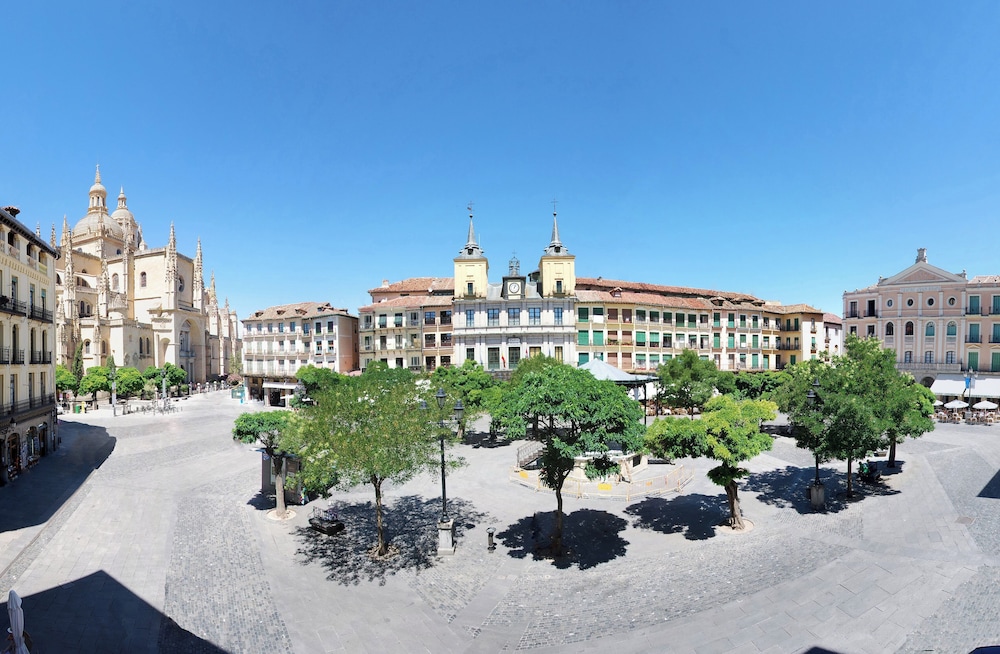
Segovia sits just over a thousand metres up on the Castilian meseta with the snow-topped Guadarrama on the horizon, and February is properly cold: daytime highs of 9-11°C, nights around -1 to 1°C, hard frost on the Alcázar lawns and ice in the shaded lanes of the Judería until midday. Rain is not the issue — February is one of the drier months, at around 25-30 millimetres — but wind off the sierra is, and it takes several degrees off whatever the thermometer says on the Plaza del Azoguejo.
The compensation is light. February gives you the crispest, clearest air of the year, when the aqueduct's granite goes honey-coloured at four in the afternoon and the sierra behind the Alcázar looks close enough to touch from the Mirador de la Pradera de San Marcos. Pack a proper coat, gloves, and shoes with grip for the cobbles, and treat the day as two outdoor sessions with a long, hot lunch wedged between them. Dark by about 18:45 at the start of the month, 19:15 by the end.
Santa Águeda in Zamarramala: the one weekend that sells out
On the weekend nearest 5 February, the village of Zamarramala — barely two kilometres from the Alcázar, across the valley — holds Santa Águeda, a festival where women take over the government of the village for the day. Two alcaldesas are elected, dressed in the heavy embroidered montera and traditional Segovian costume with silver jewellery, and lead a procession, a mass and a communal meal, with dancing and the burning of a straw figure. It has been declared a Fiesta de Interés Turístico Nacional and is the most distinctive thing on the region's winter calendar.
In 2027, 5 February falls on a Friday, so the main events should cluster around 6-7 February — but the exact programme is set each year by the Zamarramala association and the ayuntamiento, so verify before you book. What is predictable is the effect on beds: Segovia hotels that ask €65 on a February Tuesday go to €110-140 for that weekend, and the handful of rooms in Zamarramala itself vanish months ahead. Come for it deliberately or avoid the date entirely.
Carnival, and the school break nobody warns you about
With Easter falling on 28 March in 2027, Ash Wednesday lands on 10 February, which puts Carnival on the weekend of 6-9 February — right on top of the Santa Águeda dates. Segovia's own Carnival is a modest, family-scale affair of costume parades and a Burial of the Sardine rather than anything on the Cádiz scale, but the villages of the province each run their own, and it adds another layer of demand to an already tight weekend.
Schools in Castilla y León also typically take a short break of a couple of days around Carnival, on top of which some Madrid families travel. It is the one moment in an otherwise dead month when Segovia genuinely fills. Confirm the school calendar with the Junta de Castilla y León if you are trying to dodge family crowds. Book the second half of February instead and you get the same weather, the same empty monuments, and rooms back at the floor.
What a room costs, and what that buys
Outside that one weekend, February is the cheapest month of the year alongside late January. Small hostales and guesthouses on the old-town streets list doubles at €45-60. Three-stars inside the walls run €65-85 midweek, €85-105 on a Saturday. The four-star and converted-historic-building end, which asks €190 at Easter, sells Tuesdays at €95-125 with breakfast. Out on the approach roads towards Nueva Segovia and La Albuera, the larger modern hotels do €55-75 with free parking, which in February is a real convenience — you will want the car for La Granja and Valsaín.
Two things to check before booking a cheap February room: heating and single glazing. Beautiful old buildings inside the walls are not always warm ones, and a room over a bar on a narrow street can be both cold and loud. Look for reviews written in winter rather than in June, and ask directly whether the heating runs overnight. Nobody advertises a chilly room, but hotels answer the question honestly when you put it to them by email.
Open, shut and reduced
Open: the Alcázar and the Cathedral, daily, at winter hours that close earlier than in summer — check current times before setting out. The Palacio Real de La Granja opens through the winter, and its gardens, free to walk in the low season at the time of writing, are at their most theatrical under frost, with the great bare beech and chestnut avenues and the sierra behind. Confirm both hours and any garden charges with Patrimonio Nacional.
Shut or reduced: the La Granja fountains do not run in winter — the display season is warm-weather only — so do not go expecting jets. The Templar church of Vera Cruz has traditionally kept limited winter days, several small museums close Mondays, and in Pedraza, Sepúlveda and Turégano a good half of the restaurants open Friday to Sunday only. The Hoces del Duratón canoe stretch is closed for griffon vulture nesting through the winter and spring; the walking routes and the Casa del Parque in Sepúlveda remain the way to see it.
The February table
This is the month Castilian food makes total sense. Judiones de La Granja, the fat white beans grown in the shadow of the palace, stewed with chorizo and morcilla and ordered as a starter you will not finish. Sopa castellana, the garlic-and-paprika bread soup with a poached egg. Torreznos, the crisp-fried pork belly strips that arrive with a caña. Cochinillo asado — the roast suckling pig cut with the edge of a plate — is a year-round institution here, but a 20-day-old animal from a wood-fired oven eaten while it is minus one outside is a different experience from the same plate in August.
Prices hold steady all year: a menú del día of three courses with wine runs €14-18, a full cochinillo portion €25-32, a ración of judiones €12-15. February is also the season when the matanza tradition still echoes in village menus, so look for morcilla de Segovia and hearty cocido on weekend boards in Torrecaballeros and Palazuelos de Eresma. Finish with ponche segoviano, the marzipan-topped custard cake, and a cup of anything hot.
Snow, ice and the car
Snow falls in the city a handful of days most winters and rarely lies long, but it lies properly in the sierra. The CL-601 up to the Puerto de Navacerrada can require chains or winter tyres after a fall, and the pass has been closed at short notice in bad weather — check the road authority before driving it. The AP-61 and AP-6 towards Madrid are the reliable route and are gritted, but the tunnels and the pass area still see fog and black ice at dawn.
If you want the snow rather than to avoid it, La Pinilla, on the northern edge of the province near Cerezo de Arriba, is the local ski area, roughly an hour and a quarter from Segovia by road; the season depends entirely on snowfall, so check conditions and opening before committing a day. Gentler alternatives: the pinewoods of Valsaín and the Boca del Asno river walk in the snow, then judiones somewhere with a fire. That is February in Segovia at its best.
Before you book
The questions people ask about Segovia, answered with this month’s numbers.
It is tied to the feast day of 5 February and normally held on the closest weekend — in 2027 that means around 6-7 February, since 5 February is a Friday. The programme is confirmed each year locally, so check with Zamarramala's organisers or Segovia tourism, and book accommodation two to three months ahead.
In the city, a few days most winters, usually thin and short-lived; in the Guadarrama above Valsaín it is reliable. Expect frost most mornings and daytime highs of 9-11°C. If you plan to drive the CL-601 over Navacerrada, check road conditions and carry chains after any significant snowfall.
No. The fountain displays are a warm-season event and the jets stay off through winter. The palace and the gardens are still worth the 11 kilometre trip — frosted parterres and bare avenues are spectacular — but verify current opening hours and any garden admission with Patrimonio Nacional first.