Madrid to Segovia by train or bus: which one to take
 An Avant train at Segovia-Guiomar station with the Guadarrama ridge behind it
The high-speed train covers the 90-odd kilometres in under half an hour, the bus takes roughly 75 minutes, and the deciding factor is the 6 km between Segovia-Guiomar station and the aqueduct.
The one-line answer
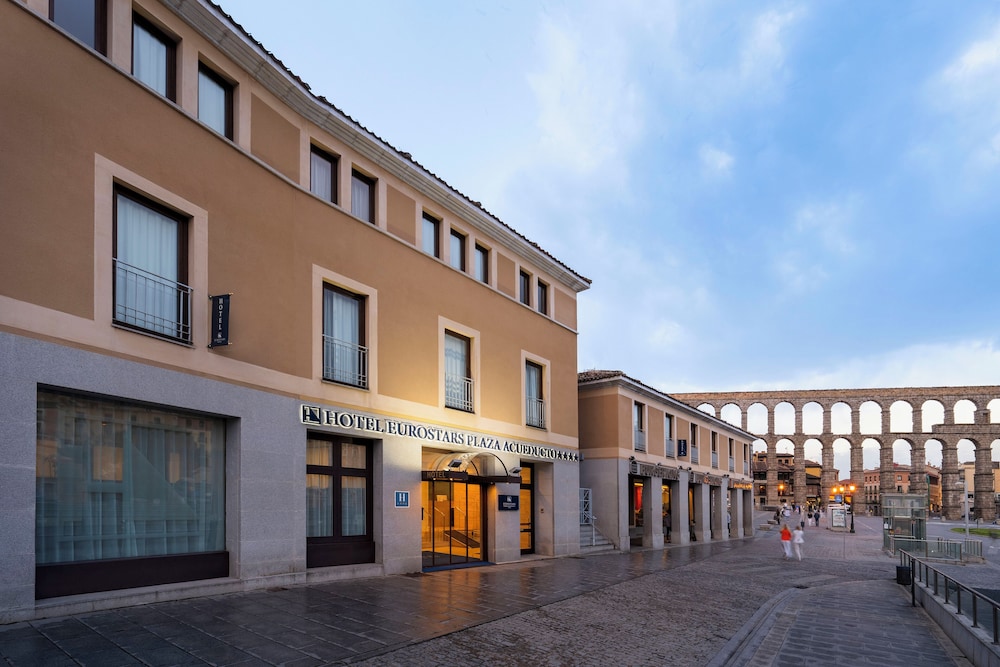
Take the bus if you are staying in the walled city with luggage, and take the train if you are doing a tight day trip and want the afternoon back. The bus from Moncloa sets you down at the Estación de Autobuses on Paseo de Ezequiel González, a flat seven or eight minutes from the Acueducto, so your journey ends where your holiday starts. The train is far faster on paper but ends at Segovia-Guiomar, out in the fields towards Hontoria, and you then have a connecting bus or a taxi before you see a single Roman arch.
That single fact reverses most people's assumptions. A 27-minute train plus a wait plus a 15-minute connection plus the walk to your accommodation is realistically an hour of door-to-door movement from central Madrid. The bus is around 75 minutes plus the walk. The gap that looked like 50 minutes shrinks to 15 or 20, and the bus is cheaper. Where the train wins outright is on frequency at awkward hours, on comfort if you get travel sick on the mountain road, and on days when the A-6 and the Guadarrama tunnel are backed up.
The train, honestly: Chamartín, Guiomar, and the last 6 km
Trains leave from Madrid-Chamartín Clara Campoamor, not Atocha, which catches out anyone who has already learned the Andalusia routine. Journey time on the Avant services is in the 25 to 30 minute range, and the same line continues to Valladolid in about another half hour, which makes Segovia a genuinely easy stop on a Castilla y León loop. Fares sit in a band of roughly €13 to €25 one way depending on service and how far ahead you book, with the cheapest seats gone first on Friday evenings and Sunday returns. Check the operator for the day's timetable rather than trusting a printed schedule.
Segovia-Guiomar is a modern box station with a car park, a taxi rank and a bus stop, and essentially nothing else. Urban line 11 links it with the city and is timed around train arrivals; the ride into the centre takes around 15 minutes and the fare is a couple of euros. A taxi from the rank to the Azoguejo runs to roughly €10 to €14 depending on time of day. If you land at Guiomar after a late train, confirm before you travel that a bus is still running, because the last connection is earlier than the last train in some timetables.
The bus, honestly: Moncloa to a seven-minute walk
Coaches run from the Intercambiador de Moncloa in Madrid, underground, signed and easy to find from metro lines 3 and 6. Departures are frequent through the day, thinning in the evening and on public holidays, and the direct services take about 75 minutes while the ones that call at villages along the way can stretch past 90. One-way fares land in the €5 to €9 range. On a weekday off-peak you can turn up and buy at the desk or on board; for Friday afternoons, Sunday evenings and the long August weekends, book a seat online in advance and pick your service deliberately.
Two things go wrong with the bus. The first is traffic: the climb over the Guadarrama and the run back into Madrid can add 20 to 40 minutes on a Sunday evening, which is exactly when everyone wants to travel. The second is that not every departure is the express, and a stopping service turns a comfortable hour into an unhappy one. Read the journey time on the ticket, not the departure board. The compensation is that you finish at the bus station on Paseo de Ezequiel González, level ground, with the aqueduct a straight walk away.
The cost comparison people get wrong
Compare door to door or the numbers lie. A cheap advance train seat at €13 becomes about €15 once you add the connecting bus, or €25 or so if two of you take a taxi in from Guiomar and split it. Double that for the return and a couple has spent something in the region of €60 to €90 on the day. The same couple on the coach spends roughly €20 to €36 all in, with no last-mile at either end. For families of four the gap widens further, because bus fares scale linearly while a shared taxi does not.
The exception is anyone travelling on an inflexible clock. If you have a museum reservation, a Sunday lunch booking at an asador, or a flight out of Barajas the same evening, the train's punctuality is worth paying for. Rail is also the better bet in January and February, when snow or ice on the mountain passes occasionally slows road traffic. If cost is the only variable, the bus wins every time; if reliability is the variable, the train does, and the price gap is smaller than the headline fares suggest.
Timing a day trip so it actually works
Leave Madrid before 09:00 and you will be under the aqueduct while the coach groups are still on the motorway. That first quiet hour in the Plaza del Azoguejo and up Calle Real is the single best-value part of the day and it is free. Aim to be at the Alcázar by 10:30 to avoid the mid-morning queue, then walk out to the Plaza Mayor for a mid-morning caña and be seated for lunch at 14:00, when Segovia eats and when the asadores are at their best rather than their busiest.
For the return, do not aim for the very last departure. Sunday evening buses fill with weekenders heading back to Madrid, and if a service sells out you are waiting 30 to 60 minutes for the next one. Book a specific seat on a service around 19:00 or 20:00, which still leaves time for the sunset light on the Alcázar from the Pradera de San Marcos. If you have taken the train, allow 30 minutes to get from the old town out to Guiomar, not 15, and confirm the line 11 timetable earlier in the day.
Arriving from Barajas, or from elsewhere in Spain
Coming straight from Madrid's airport, the cleanest chain is the Cercanías line from T4 to Chamartín, then the Avant. It keeps you on rails with luggage and avoids a metro transfer with suitcases. If you land at T1, T2 or T3 you first need the free inter-terminal shuttle to T4, so budget an extra 20 minutes. Going to Moncloa for the bus instead means metro line 8 towards Nuevos Ministerios and a change, which is doable but tiring after a long-haul flight. Check current Cercanías and metro operating hours if your flight lands late.
From other Spanish cities, Segovia is easiest via the same high-speed line: Valladolid is about half an hour away, and Salamanca and León are reachable with a change. There is no useful direct coastal or southern connection, so anyone coming up from Andalusia will pass through Madrid regardless. Do not plan around the old conventional railway line into the city; the practical intercity service is Guiomar, and anything else should be verified with the rail operator before you build a day around it.
The verdict, and when to hire a car instead
I would book the coach from Moncloa for a first visit of two or three nights in the old town, and the Avant for a single-day sprint or for onward travel to Valladolid. Neither requires you to hire a car, and inside the walls a car is a liability rather than an asset given the restricted streets and the hill. The money you save on rental covers several taxi hops to La Granja and back with change left over.
Hire a car only if your trip leans on the province: Pedraza, Sepúlveda, Riofrío, the Valsaín pine forests and the fortified towns at Turégano and Coca are poorly served by buses and thin on Sundays. In that case pick it up on your way out of Segovia rather than at the start, so you never have to park it overnight near the walls. A two or three-day rental from an office near the bus station costs far less than a week of frustration in the blue-zone parking bays.
Before you book
The questions people ask about Segovia, answered with this month’s numbers.
No. It sits roughly 6 km southeast of the walls, across open country with no continuous pedestrian route worth using. Take urban line 11, which is timed around train arrivals and costs a couple of euros, or a taxi from the rank at around €10 to €14 into the Azoguejo.
Not on a weekday off-peak, when turning up at Moncloa and buying at the desk is fine. Do book for Friday afternoons, Sunday evenings, public holidays and the August weekends, when services sell out and the next departure can be 30 to 60 minutes later.
The bus, comfortably. It ends at the Estación de Autobuses on Paseo de Ezequiel González, level ground about seven minutes from the aqueduct, whereas the train leaves you with a connection at Guiomar. If you take the train with cases, plan on a taxi rather than the connecting bus.
Yes, if you leave Madrid before 09:00. That gets you to the Alcázar around 10:30 before the mid-morning queue, leaves the walled city and cathedral for late morning, lunch at 14:00 in an asador, and the Pradera de San Marcos viewpoint before a return departure around 19:00 or 20:00.