El Salvador or San Millán: which Segovia barrio to book
 Residential street on the slope east of Segovia's Aqueduct in the El Salvador barrio
Both sit within ten minutes of the Aqueduct at €50 to €90 a night, but one is flat with a bus station and the other is a hillside of ordinary flats with free parking and a view back at the old town.
El Salvador in one paragraph
El Salvador is the residential slope east of the Aqueduct, climbing away from the Plaza del Azoguejo past the parish church that names it and out along Avenida Padre Claret and the streets around Vía Roma. It is a barrio of mid-century apartment blocks, corner bars, schools and small businesses, with almost no visitor infrastructure of its own beyond a handful of hostales, guesthouses and short-let flats. The one thing it has that money cannot buy inside the walls is perspective: from the upper streets you look back across the valley at the Aqueduct arcade and the whole walled silhouette.
That view is the honest reason to consider it. Rooms and flats on the upper floors of the eastern slope get the old town framed in the window, and at night, when the Aqueduct is lit, it is a better outlook than most old-town rooms manage. The rest of the barrio is unremarkable in the way that residential Spain is unremarkable, which is to say it works: bread at eight, a bar with a set lunch, kids playing at seven, no coach parties at any hour.
The head-to-head on price
El Salvador and San Millán occupy the same price band, and both undercut the walled town heavily. Expect doubles at €50 to €85 midweek outside high season in El Salvador and €55 to €90 in San Millán, with weekend and June rates €20 to €35 higher in both. Whole flats run €70 to €120 for two bedrooms on either side of the Aqueduct. Neither area imposes a meaningful festival premium compared with the old town, where the same weekend can add €70 to a room.
Where they part company is parking. San Millán has hotel garages at €8 to €12 a night and metered surface bays; El Salvador, being residential and further from the regulated core, has genuinely free street parking on its upper streets, though you may circle for ten minutes at 8pm on a weekday when residents are home. For a driver staying five nights, that is €40 to €60 of difference. For a traveller without a car, it is irrelevant, and San Millán's flat ground wins instead.
Walking times compared
From San Millán to Plaza del Azoguejo and the Aqueduct: three to six minutes, flat. From El Salvador: eight to fourteen minutes depending on how high up the slope you are, downhill going in and uphill coming home. From San Millán to the Plaza Mayor: 13 to 16 minutes. From El Salvador: 18 to 24. Neither is far, but the direction of the gradient matters, and El Salvador delivers its climb at the end of the evening rather than the start of the day.
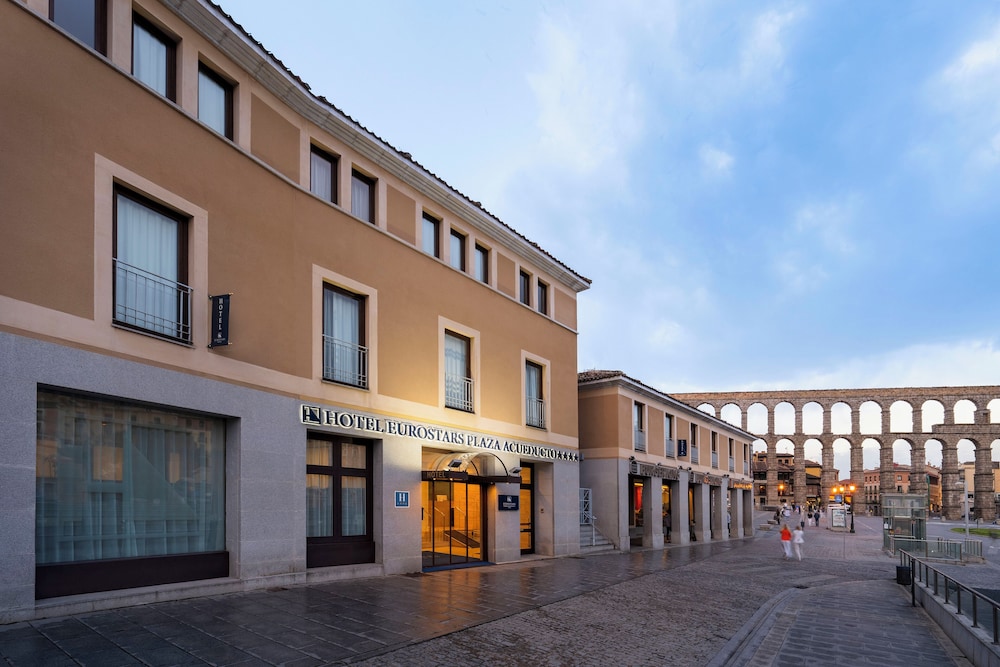
The compensation is that the El Salvador approach to the Aqueduct is the good one. You come down towards the arcade with the monument growing in front of you and the old town rising behind it, rather than arriving side-on through the shopping streets. Walk the last stretch down Vía Roma at dusk once and you will forgive the barrio a lot. For bus arrivals, though, San Millán is unarguable: the station on Paseo de Ezequiel González is five to eight minutes away on the level.
What each barrio gives you day to day
San Millán has the shops. Avenida Fernández Ladreda and its side streets carry supermarkets, pharmacies, bakeries selling ponche segoviano, bank branches and enough bars that you can compare set lunches at €13 to €16. It also has the Romanesque church of San Millán, a real monument with a Mudéjar brick tower, sitting in its own square two minutes from the hotels. If you want to be able to buy anything at all without thinking, this is the better choice.
El Salvador has quiet and altitude. Its bars are neighbourhood bars where a coffee is under €2 and nobody speaks English at the counter, its streets empty out by eleven, and its supermarkets are fewer but adequate. Families staying a week in a flat here often prefer it because there is space, free parking, a park or two, and no through traffic from the tourist route. Weekend visitors generally prefer San Millán, because everything is closer and the walk home is flat.
The catches on both sides
San Millán's catch is traffic. Avenida Fernández Ladreda carries buses and morning deliveries, and rooms facing it are noisy from around 7am. Book a courtyard or a side street. Its second catch is atmosphere: the frontages are 1960s and 1970s, and if you came for cobbles you will not find them until you climb Calle Cervantes. Its third is that fiesta-week rooms do get taken, later than in the old town but they do go.
El Salvador's catch is that it is a place to sleep rather than a place to be. There is nothing to do in the barrio after dinner, few places to eat well, and the walk home is uphill in the dark. Its second catch is the housing stock: many buildings are walk-ups without lifts, so check before booking a fourth-floor flat with heavy bags. Its third is that street parking, while free, is contested by residents on weekday evenings and around school pick-up hours.
Which one I would book
Arriving by bus or train, staying two or three nights, no car: San Millán, every time. Flat ground, five minutes to the Aqueduct, shops, set lunches, and no evening climb. Ask for a quiet room and you will have no complaints. It is also the better answer for anyone travelling with a pushchair or a suitcase with small wheels, which is most people, and for anyone who wants to be able to walk home at one in the morning without thinking about gradients.
Arriving by car, staying four nights or more, ideally in a flat with a kitchen: El Salvador. You save on parking, get more space for the money, sleep in a residential street with no bar noise, and if you choose your floor and orientation carefully you wake up looking at the Aqueduct. Families and slow travellers do well here. Anyone spending two nights and wanting Segovia handed to them should not be in either barrio; pay the €30 to €60 premium and sleep inside the walls.
Booking notes for both
Ask three questions of any property in either barrio: is there a lift, which way does the room face, and is parking included or free nearby. Those answers decide the quality of the stay more than star ratings do. In El Salvador, also ask how far the flat is above the Aqueduct in walking minutes, since listings measure generously and the difference between eight minutes and fourteen is a whole different holiday when repeated four times a day in August heat.
Both areas hold availability later than the walled town for the big dates, late June fiestas, Semana Santa, the May street-theatre festival, the September festival weekend and 25 October, but they are not immune. Book four to six weeks out for those, two weeks otherwise. Rates in both bottom out from mid-January to early March, when Segovia is cold, clear and half-empty, and a flat that costs €110 in June can be had for €60. Verify prices for your dates rather than trusting bands.
Before you book
The questions people ask about El Salvador, answered with this month’s numbers.
San Millán, at three to six minutes on flat ground, against eight to fourteen minutes from El Salvador with an uphill return. San Millán is also five to eight minutes from the bus station, which decides it for anyone arriving by coach with luggage.
On the upper residential streets, generally yes, though you may spend ten minutes finding a space on weekday evenings when residents are home. San Millán relies more on metered bays and hotel garages at €8 to €12 a night. For a five-night driving trip that difference is worth €40 to €60.
From upper-floor rooms on the eastern slope, yes, with the arcade and the walled skyline framed across the valley and lit at night. It is not guaranteed, so ask the property directly which way the windows face before booking on the strength of the view.