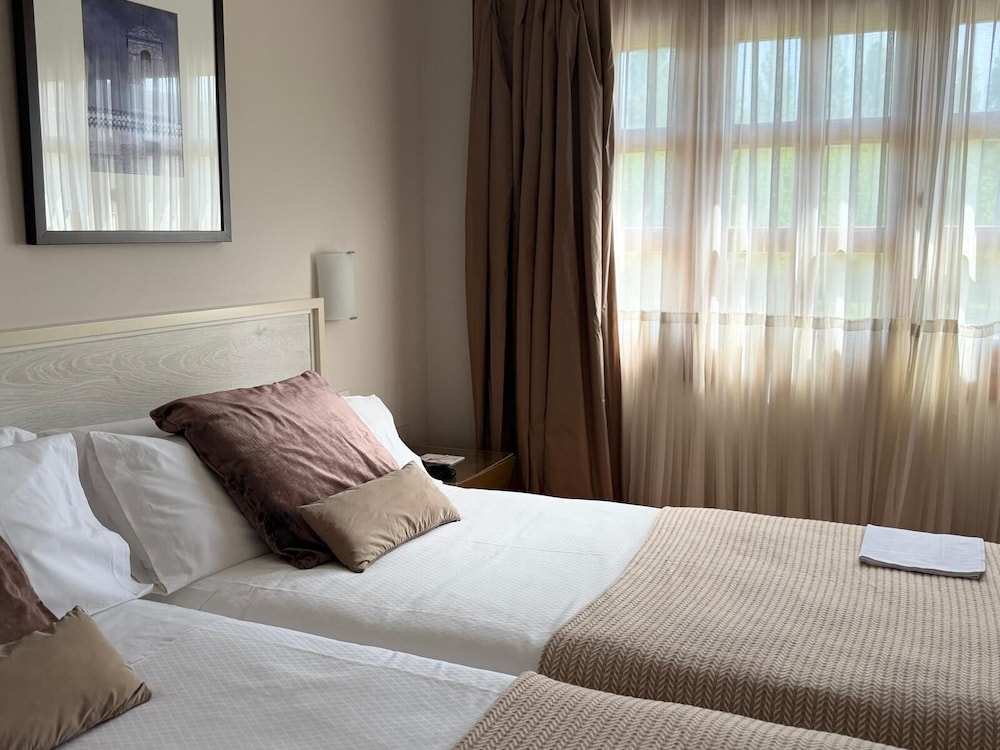
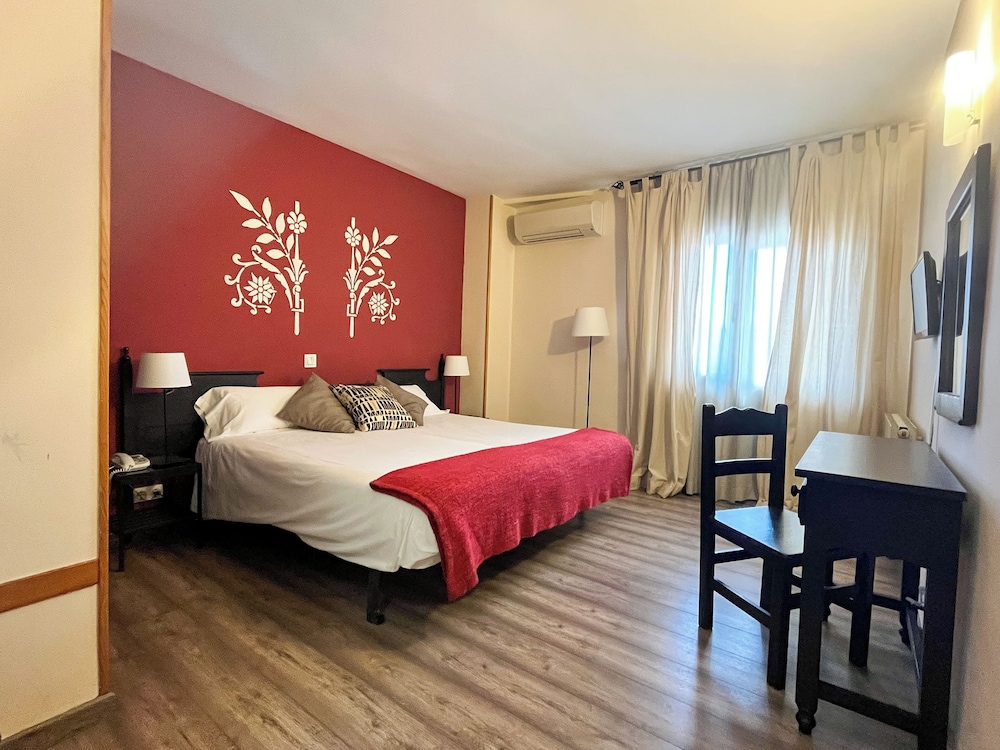
Where to stay in Torrecaballeros: the asador village 10 km from the Aqueduct
 Stone asador buildings and sierra pinewoods on the edge of Torrecaballeros
A driver's base at 1,140 m where doubles run about €70-105 and the car park is free, ten minutes up the N-110 from Segovia.
Who this village actually suits
Torrecaballeros works for one specific traveller: the person arriving by car, planning three or four days that stitch together the Aqueduct, the gardens at La Granja and the northern flank of the Sierra de Guadarrama, and who would rather wake at 1,140 metres with pine air coming through the window than above a delivery route in the Casco Antiguo. Ten kilometres of the N-110 separate the village from Segovia, which is twelve to fifteen minutes when the road is clear. Parking sits outside the door and costs nothing, against roughly €14-18 a night for a city hotel garage.
It suits families and groups of four to eight even better, because the local stock leans towards whole houses and converted farm buildings with a kitchen, a wood burner and space to leave walking boots by the door. It also suits people who like to eat seriously at lunch and do very little afterwards. Book somewhere else if you want the Aqueduct floodlit at eleven at night, if you want a choice of bars after midnight, or if you are in Segovia for a single night before flying home. One night out here is logistics without payoff.
What a night costs against the city
Rural doubles in and around the village typically sit in the €70-105 band, breakfast sometimes included and sometimes an extra €8-12 a head. That undercuts the €85-120 you pay for a comparable mid-range double inside Segovia's walls in high season, and the gap widens once parking is counted. Whole houses sleeping six to eight tend to run €140-230 a night with a two-night minimum at weekends, which is the cheapest way for a group to sleep well anywhere in this corner of the province.
The spikes are predictable. Long weekends, the days around Christmas and New Year, and Saturdays in July and August push prices up by a third or more, and some houses will not take a single Saturday at all. Midweek in February or early November is when this village is a bargain: I have seen good stone-walled doubles at €60-70 with a fire lit in the sitting room. If your dates are fixed to a Saturday in high summer, compare against Palazuelos de Eresma or the city itself before assuming the village is cheaper.
The walking radius, honestly measured
You can cross the built-up part of Torrecaballeros on foot in about fifteen minutes. Within that circle you have the parish church, a small handful of bars where the coffee costs €1.60 rather than the €2.20 you pay by the Aqueduct, a bakery, a pharmacy and a supermarket adequate for breakfast supplies and little else. The most interesting buildings are the old esquileos, the 18th-century merino shearing sheds whose thick stone walls and enormous roofs still define the village silhouette. Several have been converted; you will walk past them without noticing unless you look for the scale.
Beyond the houses, tracks climb north-east through oak and pine towards the hamlet of Cabanillas del Monte, an easy hour there and back with wide views to the Guadarrama ridge. What is not walkable is Segovia. The N-110 has no continuous footpath, traffic moves at 90 km/h and people do attempt it — do not. If you want to end an evening walking home along a lit street with restaurants on it, this decision is already made for you and the answer is the city.
Eating: the reason half the guests come
The village is a roast-meat destination for Segovians themselves, and the asadores strung along and just off the N-110 fill on Sundays with families driving out from the city. Cochinillo asado carved with the edge of a plate, cordero lechal from a wood oven, judiones de La Granja stewed with chorizo, and in October the ponche segoviano or a plate of wild níscalos. A full Sunday lunch with wine lands around €40-55 a head at the serious places, and €25-30 at the plainer ones. Book Sunday by Thursday; walk-ins at 2.30pm get turned away.
The practical advantage of sleeping here is that you can drink at that lunch and walk back. The practical disadvantage is dinner: several kitchens do lunch only, or open evenings on Fridays and Saturdays alone, and by 10pm midweek in winter the village is asleep. Ask your host to reserve when you book the room, and keep a fallback of bread, cheese and a bottle from the supermarket. If you want a second night of eating out, Sotosalbos, eight kilometres east on the N-110, has its own well-regarded roast houses beside a Romanesque porch.
What the car reaches in under 40 minutes
This is the best-placed village in the batch for touring. Segovia is 10 km, La Granja de San Ildefonso about 12 km over the ridge road, Riofrío and its deer park roughly 20 km on the far side of the city, and the Puerto de Navacerrada around 25 km up into the Sierra de Guadarrama National Park. Pedraza is 28 km north-east on quiet secondary roads, and Sepúlveda about 50 km. You can do a morning in the gardens, lunch at the hotel and an afternoon in the old town without ever repeating a road.
Park in the city at one of the peripheral pay car parks rather than trying the walled streets, or use the free spaces beyond the Alcázar side and walk in downhill. Coming back after dark, the N-110 is unlit but straight; deer and wild boar cross between Sotosalbos and the village in autumn, so hold 70 km/h rather than 90. If your itinerary is city-heavy — three museums, two churches, the cathedral, evening tapas — the driving becomes a tax and you should book inside the walls instead.
Arriving without a car
It can be done, but not comfortably. Regional coaches on the Segovia-to-Soria corridor stop on the main road through the village, and there are local services linking the sierra villages with Segovia's bus station; frequencies are built around school and commuter hours, thin at weekends, and they change. Check the current timetable with the operator before you commit, and never assume a late-evening return from the city exists. A taxi from Segovia costs roughly €20-25 each way and needs to be booked back out to you rather than hailed.
That maths kills the price advantage fast: two taxi runs a day for three days is more than the parking you saved. So the rule is simple. Car, and the village is a smart, quiet, good-value base. No car, and you want the Casco Antiguo, San Millán or the streets around the bus station, where everything you came for is within a twenty-minute walk and the last coffee of the night is fifty metres away.
Seasons, and when to actually book
Altitude sets the calendar. Nights here run several degrees colder than in the city, frost is normal from November to March, and snow closes nothing but slows the ridge road to La Granja a few days each winter — carry chains in January and February if you plan on the puertos. Check a room has real heating and, ideally, a wood burner; the stone houses are glorious and slow to warm. Summer is the inverse pleasure: 32 °C afternoons collapse to 14-16 °C after dark and you will want a jumper on the terrace.
My picks are late September to early November, when the oaks turn, the mushroom season fills the menus and rates drop back to the €65-85 band, and mid-May to mid-June, when the sierra is green and the National Park trails are open without August crowds. Skip the first fortnight of August if you want quiet: Segovians decamp to the villages, the asadores run two full sittings and prices sit at their ceiling. If you can only travel in August, book eight to ten weeks out.
Before you book
The questions people ask about Segovia, answered with this month’s numbers.
No. It is 10 km along the N-110, a fast road with no continuous pavement and unlit verges. Drive it in twelve to fifteen minutes, use the regional coach if the timetable suits, or budget €20-25 for a taxi each way. Do not attempt it on foot after dark.
Usually. Rural doubles run about €70-105 against €85-120 for equivalent mid-range city rooms in high season, and parking is free rather than €14-18 a night. The saving disappears if you need taxis, so it only holds if you have your own car.
Not guaranteed. Several asadores serve lunch only, or open evenings just on Fridays and Saturdays, and midweek winter dinner service is thin. Ask your host to reserve a table when you book the room, and keep supermarket bread and cheese as a backup.
Yes, one of the best on the Segovia side. The Puerto de Navacerrada is roughly 25 km, La Granja and the Valsaín pinewoods about 12-15 km, and you start each day above 1,100 m rather than driving up from the plain.