Where to stay in the Judería, Segovia
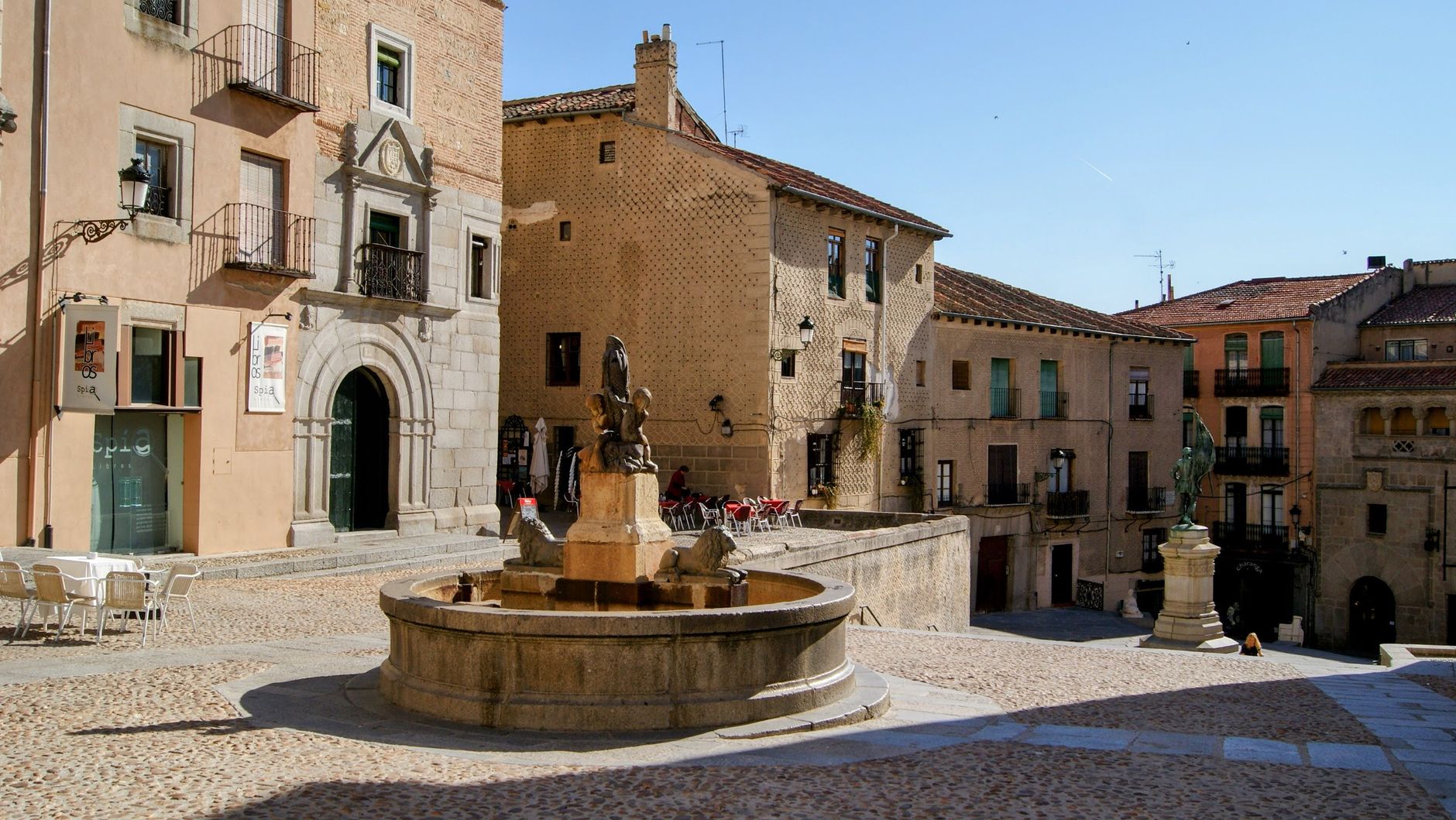 Narrow lane in Segovia's old Jewish quarter leading towards the Puerta de San Andrés
Segovia's old Jewish quarter sits four minutes from the Plaza Mayor, costs about €10 to €25 a night less than the streets around the cathedral, and asks you to accept slopes, steps and an early curfew on noise.
Where the quarter actually begins and ends
The Judería occupies the southern slope of the walled spur, dropping from Calle Juan Bravo and Plaza de Medina del Campo down towards the city wall and the Clamores valley. Its spine is Calle Judería Vieja, joined by Calle Judería Nueva, Calle Martínez Campos and the short lanes that funnel into the Puerta de San Andrés. It is inside the walls, so everything said about the old town applies, but the atmosphere is different: fewer shopfronts, more closed doors, the sound of your own footsteps after nine, and a wall-top view over the valley at the end of most streets.
Because the boundary is soft, listings describe wildly different addresses as being in the Judería. The test that matters is whether you are above or below Calle Juan Bravo. Above it you are in the commercial core with its bars and coach traffic; below it you are in the quiet quarter with the gradients. Check the street name against a map before booking and count the metres to the Puerta de San Andrés, because a room on the wall line is a very different stay from one thirty seconds off the main shopping street.
Who this quarter suits
It suits returning visitors who already know the Aqueduct and want somewhere to sleep that feels lived in rather than staged. It suits couples who eat late and then want silence, photographers who want the wall and the Clamores valley two minutes from the door at first light, and anyone with an interest in Sephardic history, because the Corpus Christi church, which was the quarter's principal synagogue, the Centro Didáctico de la Judería in the house of Abraham Seneor and the Museo de Segovia in the Casa del Sol are all within a five-minute radius of one another here.
It does not suit anyone with knee or hip trouble, anyone travelling with a pushchair, or anyone who wants to step out of the door into a lively street. The gradients are constant, the surfaces are cobble and worn granite, and the Puerta de San Andrés route down to the valley involves steps and a steep ramp. It also does not suit large groups: the buildings are small, rooms are often two or three to a floor, and connecting family rooms are rare. Groups of six or more will find better options in San Millán.
What a night costs here
Doubles in the small hotels and guesthouses of the Judería typically run €75 to €130 midweek outside high season and €110 to €180 at weekends and in June, which puts the quarter roughly €10 to €25 below equivalent rooms facing the Plaza Mayor and the cathedral. Simple guesthouse rooms with a shared landing bathroom still exist in the lower streets at €55 to €75. Apartments, of which there are a good number in the restored houses, sit around €90 to €140 for two bedrooms and are the best value in the quarter for a stay of three nights or more.
The saving is real but modest, and you pay for it in altitude change. Judge whether that trade is worth it by how many times a day you plan to return to the room. If you are the kind of traveller who goes back at 2pm for a siesta and again at 7pm to change, you will climb from Calle Juan Bravo four times a day, and the €20 you saved will feel expensive. If you leave at nine and come back at eleven, the Judería is the sharpest value inside the walls.
The slopes, steps and cobbles, honestly
From the Puerta de San Andrés up to the Plaza Mayor is about 400 metres and something like 25 to 30 vertical metres, which sounds trivial written down and does not feel trivial on the fourth ascent of the day in August heat. The lanes are narrow, granite-paved and often crowned in the middle for drainage, which is unkind to suitcase wheels and to anyone using a stick. Several houses have entrance thresholds and half-flights of stairs before you even reach the reception desk.
Practical fixes: arrive with a soft bag rather than a hard case, book a room on the first floor or below unless the building has a lift, and confirm with the property whether there is any vehicle access for unloading, since much of the quarter is closed to through traffic. If mobility is a genuine constraint, the flat streets of San Millán below the Aqueduct give you the same city for less money and a five-minute bus into the walls. Nobody should book the Judería on the strength of photographs alone.
Walking distances from a Judería room
Plaza Mayor and the cathedral: four to six minutes uphill. The Aqueduct at Plaza del Azoguejo: eight to eleven minutes, mostly downhill along Calle Juan Bravo and Calle Cervantes, and a real climb coming back. The Alcázar: ten to twelve minutes west. The Puerta de San Andrés and the Museo de Segovia: two to four minutes. The Paseo del Salón, with its balcony over the Clamores and the best close view of the southern wall, is under five minutes and is the quarter's outdoor living room on summer evenings.
Outside the walls, the Cuesta de los Hoyos path drops from San Andrés into the Clamores valley and lets you walk the base of the wall towards the Alcázar in about 25 minutes, which is the most underrated hour in Segovia and starts on your doorstep. The old Jewish cemetery ground at El Pinarillo, on the far slope of the Clamores, is a 20-minute walk with a climb. For La Granja, Pedraza or the Guiomar high-speed station you need the bus station or a taxi, both reached via the Aqueduct.
Eating when you sleep here
The Judería itself has only a handful of places to eat, and several close early or shut on Sunday evenings and Mondays. In practice you eat on Calle Juan Bravo, around Plaza de San Martín, or five minutes further at the classic Segovian roasting houses near the Aqueduct and behind Plaza Mayor, where cochinillo asado on a set menu tends to run €30 to €45 a head with wine. For something lighter, the bars around Plaza de Medina del Campo do tapas plates and torreznos for a fraction of that.
The upside of the quarter's thin restaurant density is that nothing under your window is serving until 1am. The downside is that a wet Tuesday in February can leave you walking ten minutes for dinner in near-freezing air. Buy breakfast supplies during the day, because there is no supermarket in the quarter itself and the nearest useful ones are outside the walls. Book the well-known roasting houses two or three days ahead in high season, and considerably further ahead for fiesta weekends, when the walled town fills entirely.
The verdict, and when to book
Book the Judería if you want an old-town base with quiet nights, you are travelling as a couple or a pair of friends, you have two working knees and you are here for at least three nights so the apartment rates come into play. Ask for a room facing south or west, towards the valley, both for the light and because those windows are the ones with a view. Ask also whether the building has a lift; in this quarter that single question separates a pleasant stay from a daily ordeal.
Book elsewhere if the trip is a one-night stopover with a car, if anyone in the party has mobility limits, or if you want to walk out into the noise rather than away from it. Rates here follow the rest of the walled town: highest in late June, Semana Santa, the May street-theatre festival and the late-September and October festival weekends; lowest from mid-January to early March, when hard frosts and the occasional snowfall keep visitor numbers down and some smaller properties close for a few weeks.
Before you book
The questions people ask about Judería, answered with this month’s numbers.
Yes. It occupies the southern slope of the walled spur, below Calle Juan Bravo and above the Puerta de San Andrés, so you are inside the walls with the cathedral four to six minutes uphill. The trade is gradient: expect 25 to 30 vertical metres of climb on every return.
Roughly €10 to €25 a night, with doubles at €75 to €130 midweek off-season against €90 to €150 in the cathedral streets. Two-bedroom apartments at €90 to €140 are the better value here for stays of three nights or more.
Only partly. Much of it is closed to through traffic and several lanes are stepped. Ask your accommodation in advance whether it can register your plate for unloading, then use a paid car park on the edge of the walls at around €14 to €20 for 24 hours. Confirm the rules directly.
Only a few, and some close on Sunday evenings and Mondays. In practice you eat on Calle Juan Bravo, around Plaza de San Martín, or near the Aqueduct, all within ten minutes. There is no supermarket in the quarter, so buy breakfast supplies outside the walls during the day.