Where to stay in Casco Antiguo, Segovia
 Cobbled street inside Segovia's walled old town rising towards the cathedral tower
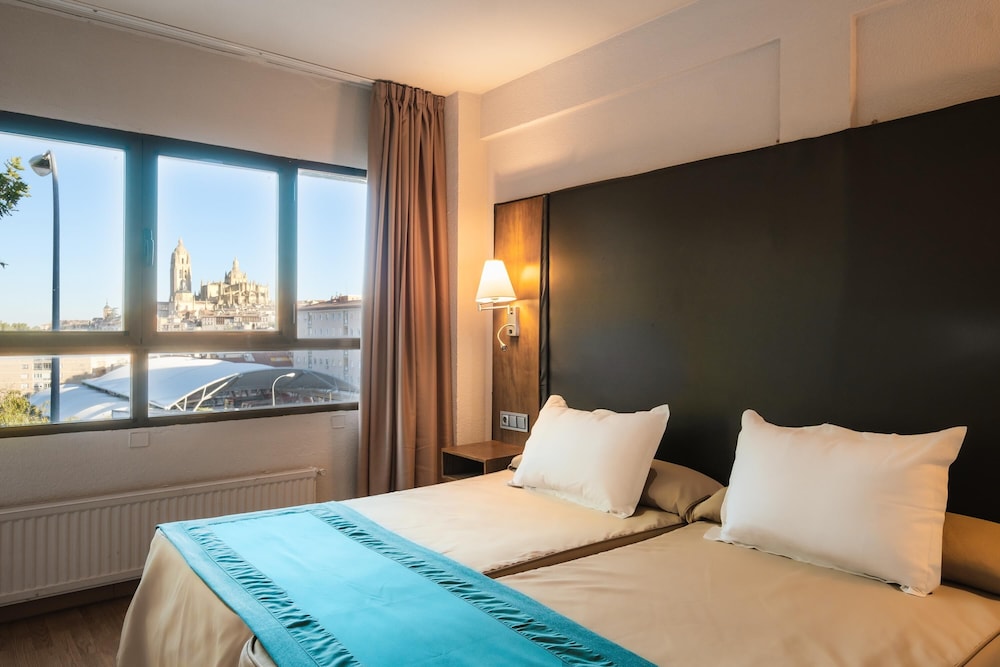
The walled town holds most of Segovia's higher-end rooms and charges roughly €30 to €60 a night more than the barrios below it, so here is which stretch of it to book and when to sleep somewhere cheaper.
Who should sleep inside the walls
Book here if you have one or two nights and want the Aqueduct, the cathedral and the Alcázar all within a fifteen-minute walk of your key. The walled spur is barely 1.2 kilometres from the Plaza del Azoguejo at the eastern end to the Alcázar terrace at the western tip, which means you can be out at 7.30am photographing empty streets and back in bed by 11pm without ever unlocking a car. Short-stay visitors who count travel time as lost holiday nearly always come out ahead here, even paying the premium, because the walk to dinner is four minutes rather than a bus ride.
Skip it if you are driving and staying four nights or more, travelling with a heavy case and no lift, or bringing anyone who struggles with gradients. The old town is granite cobble, sloping in every direction, and a fair share of its guesthouses occupy 18th-century houses with narrow stairs. Families with a pushchair and a week to fill get better value in San Millán or San José, where the pavement is flat, parking is free and the Aqueduct is ten minutes away. The premium buys proximity, not comfort, and it is only worth paying if you will use it hard.
Three micro-zones inside the walls, and what each one is like
The Azoguejo end, around the foot of the Aqueduct and the bottom of Calle Cervantes, is the busiest and the easiest to reach with luggage: buses and taxis stop nearby, and you can roll a case in from the street without a serious climb. It is also the noisiest, and the most exposed to coach groups between 10am and 5pm. The Plaza Mayor core, taking in Calle Isabel la Católica, Calle Infanta Isabel, Plaza de San Martín and the lanes behind the cathedral, is the classic choice: rooms over the square, bells you will hear, and every restaurant within three minutes.
The western third, from Calle Marqués del Arco and Calle Daoíz out to the Alcázar, is the quiet one. Fewer bars, more parish silence, views over the Eresma from the gaps between houses, and a five-minute walk back to the Plaza Mayor when you want life. That is where I would book a second visit. First-timers with two nights should take the Plaza Mayor core and accept some noise; anyone arriving late by train or bus with luggage should look at the Azoguejo end, then walk uphill in the morning with empty hands.
What a night actually costs here
Expect roughly €90 to €150 for a double in a mid-range old-town hotel on a midweek night outside high season, rising to €130 to €220 on a Friday or Saturday and during the June fiestas, Semana Santa and the September and October festival weekends. Small family-run guesthouses in the side streets sit lower, around €65 to €95, usually without a lift and sometimes without air conditioning, which matters in July and August when afternoons reach the low thirties. The handful of restored palace and convent conversions run €160 to €260 in peak weeks.
Compare that with €50 to €85 in the outer barrios for a comparable double, and the walled town is charging a premium of roughly €30 to €60 a night. For a two-night trip that is €60 to €120 total, which is less than the price of one parking bay plus two taxi runs, so the maths favours staying inside. For a five-night stay it is €150 to €300, at which point San Millán, El Salvador or San José start to look sensible. Rates soften noticeably from mid-January to early March, when frost keeps the coach parties away.
Noise: the streets that stay loud
Calle Infanta Isabel, nicknamed the street of the bars, is the loudest address in the walled town and it does not settle until the small hours on Friday and Saturday. The lanes running off Plaza Mayor towards Calle Escuderos and Plaza de Medina del Campo catch some of the same spill. If your window faces any of those, ask for an interior or courtyard room when you book rather than on arrival, because the good rooms go first. Cathedral bells and the quarter-hour chimes are part of the deal in the core, and no amount of glazing fully removes them.
The quietest bookable pockets inside the walls are the Marqués del Arco and Daoíz stretch towards the Alcázar, the lanes behind San Esteban, and the upper Judería streets. Street cleaning and delivery vans start early throughout the old town, typically well before 8am, and the granite surface amplifies every wheel. Light sleepers should treat earplugs as standard kit here and should not book a first-floor room over a pedestrian street in June. If silence is the priority above all else, the Eresma valley barrios below the walls are a better answer than any old-town room.
Arriving with a car or a big suitcase
Vehicle access to much of the walled town is restricted, and several streets are effectively residents and deliveries only. Hotels inside the walls can usually arrange temporary access for unloading, but you must ask in advance and give them your plate; turning up and improvising is how people collect fines. Confirm the procedure directly with your accommodation, since the enforced zones and the way permits are issued do change. Once unloaded, most guests park in one of the paid underground car parks on the edge of the old town, at roughly €14 to €20 for 24 hours.
If you are on foot from the bus station on Paseo de Ezequiel González, it is about ten minutes to the Aqueduct on the flat and then a climb of some 30 vertical metres up Calle Real to Plaza Mayor, which takes another nine or ten minutes with a case rattling over cobbles. From the Segovia-Guiomar high-speed station, roughly 6 kilometres out, take the city bus timed to train arrivals or a taxi at around €12 to €15; check fares with the operator before you count on a figure. Small wheels on suitcases suffer badly here.
What is genuinely within walking distance
From a room near Plaza Mayor: the cathedral is on the square, the Alcázar is seven to eight minutes west along Calle Marqués del Arco and Calle Daoíz, the Aqueduct is nine or ten minutes downhill along Calle Real, and the Iglesia de San Martín and the Torreón de Lozoya are two minutes away. The Museo Esteban Vicente, the Casa-Museo de Antonio Machado on Calle Desamparados and the Puerta de San Andrés with the Museo de Segovia beside it are all inside ten minutes. Nothing in the walled town is more than twenty minutes from anything else in it.
Beyond the walls, the good walks start at your door. Down through the Puerta de Santiago into the Eresma valley for the Vera Cruz church and the Monasterio de El Parral is 15 to 20 minutes each way, with a stiff return climb. The Pradera de San Marcos, the classic postcard angle on the Alcázar, is about 25 minutes down and 35 back. South, the Paseo del Salón and the Cuesta de los Hoyos give you the Clamores valley and the wall from below in half an hour. Day trips to La Granja need the bus.
When the walled town sells out
The dates to book months ahead are the Fiestas de San Juan y San Pedro in late June, Semana Santa, the Titirimundi street-theatre and puppet festival in May, the Hay Festival weekend in September and the San Frutos patronal day on 25 October. Long weekends built around Spanish public holidays also empty the old town of rooms, and Madrid visitors take a large share of them because the high-speed train from Chamartín is under half an hour. On those dates, rooms inside the walls can be gone eight weeks out while the outer barrios still have space.
For the best combination of price and atmosphere, aim at a Sunday to Thursday stay in late September, early October, or the first half of November: mild days, cold clear nights, full restaurant service and rates near the bottom of the band. February is cheaper again but genuinely cold, with hard frosts and occasional snow at 1,000 metres, and some smaller guesthouses close for a few weeks after the New Year. Always confirm opening dates for family-run places directly, because winter closures are decided late and are rarely advertised well in advance.
Before you book
The questions people ask about Segovia, answered with this month’s numbers.
Yes. The premium is roughly €30 to €60 a night, so €60 to €120 for two nights, which is less than parking plus taxis and buys you early-morning and after-dark access to empty streets. For stays of four nights or more, the maths swings towards San Millán or San José.
Usually only to unload, and only if the hotel registers your plate in advance for the restricted streets. Ask before you arrive, then move the car to a paid underground car park on the edge of the walls at around €14 to €20 for 24 hours. Verify the current access rules with your accommodation.
The western third, between Calle Marqués del Arco, Calle Daoíz and the Alcázar, plus the lanes behind San Esteban. Avoid Calle Infanta Isabel and its side streets at weekends. Ask specifically for an interior or courtyard room; cathedral bells carry across the whole core regardless of which street you choose.