San Millán or Casco Antiguo: which to book in Segovia
 The Romanesque church of San Millán with its brick tower below the Aqueduct in Segovia
San Millán is the flat, unglamorous barrio five minutes below the Aqueduct where doubles run €55 to €90, and for anyone arriving by bus, driving, or staying more than three nights it beats the walled town on every practical measure.
What San Millán is
San Millán is the district immediately south and east of the Aqueduct, spread around the 11th-century Romanesque church that gives it its name and along Avenida Fernández Ladreda, the broad partly pedestrianised street that runs from Plaza del Azoguejo down towards the old railway station. This is where Segovians shop: pharmacies, shoe shops, a couple of bakeries selling ponche segoviano by the slice, banks, and bars where the set lunch is €13 to €16 rather than €35. It is not picturesque in the way the walled town is picturesque, and that is exactly its usefulness.
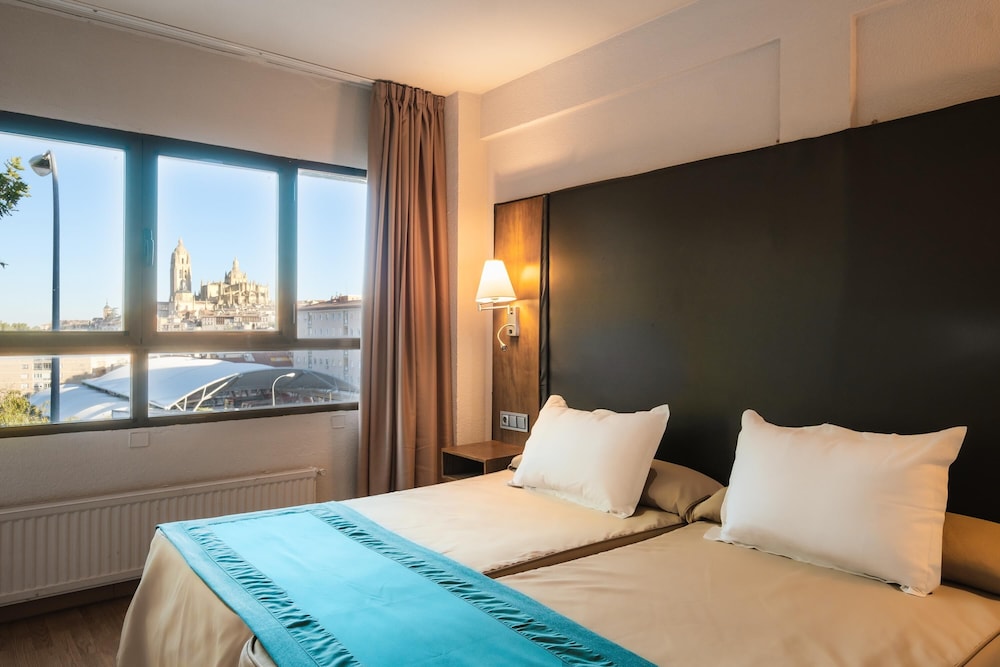
The church of San Millán is worth ten minutes of anyone's time even if you are only sleeping here: a full Romanesque plan with exterior galleries and a brick Mudéjar tower, sitting in a small square that most visitors walk straight past on their way to the Aqueduct. Around it the streets are mid-20th-century blocks with lifts, wide pavements and level surfaces, which is a rarer combination in Segovia than you would think. The Aqueduct's arcade is visible from a surprising number of upper-floor windows here.
The price gap, in numbers
Doubles in the mid-range hotels and hostales along and behind Avenida Fernández Ladreda typically run €55 to €90 midweek outside high season and €75 to €120 at weekends and in late June. Equivalent rooms inside the walls run €90 to €150 midweek and €130 to €220 at weekends. Call it €30 to €60 a night of difference, consistently. Over a four-night stay that is €120 to €240, which pays for two cochinillo dinners at one of the famous roasting houses with change left over.
The other saving is parking. Inside the walls you are looking at €14 to €20 a day in an underground car park; in San Millán and the streets sloping away from it there is metered surface parking and, beyond the regulated zone, free street parking that is realistic to find outside fiesta weekends. Several of the barrio's hotels have their own garage at €8 to €12 a night. For a driving trip of three nights, the combined room and parking saving against the old town easily reaches €150.
Arrivals: the barrio built for them
The bus station on Paseo de Ezequiel González sits at the edge of San Millán, five to eight minutes on the flat from most of its hotels. If you are coming from Madrid on the Moncloa coaches, that is your door. The old conventional railway station on Paseo Obispo Quesada, used by the slow Madrid line, is a ten-minute walk south. The Segovia-Guiomar high-speed station is about 6 kilometres out, served by city buses timed to train arrivals and by taxis at roughly €12 to €15; check the fare and timetable with the operators before relying on them.
Drivers arriving from the A-1 or the AP-61 approach through the southern avenues and never have to attempt a restricted old-town street, which removes the single most common source of holiday stress in Segovia. Luggage is the clincher: from the bus station to a San Millán hotel is flat tarmac, while from the bus station to the Plaza Mayor is a kilometre with roughly 30 vertical metres of cobbled climb. Anyone with a hard case, a child, or a bad back should read that sentence twice.
Walking distances that matter
Plaza del Azoguejo and the Aqueduct: three to six minutes, flat. The Iglesia de San Millán: on the doorstep. Plaza Mayor and the cathedral: 13 to 16 minutes, all of it uphill on the way there and pleasantly downhill on the way back. The Alcázar: 22 to 26 minutes across the length of the walled spur. Bus station: five to eight minutes. In other words, the sight most people come for is closer from San Millán than it is from a room at the Alcázar end of the old town.
For evenings, that geometry works well. You climb once, eat and drink in the walled town, then roll back downhill at midnight rather than dragging yourself up Calle Real. The one journey San Millán makes awkward is the Eresma valley: reaching the Vera Cruz church, El Parral or the Pradera de San Marcos means crossing the whole old town first, so budget 35 to 45 minutes each way. If those riverside walks are your main reason for coming, look at San Marcos or San Lorenzo instead.
Who should still book the walled town
One-night visitors, anyone celebrating something, and travellers who value stepping out of the door into a 15th-century street more than they value €40. If you are here for a single Saturday, the old town wins outright: you will spend that night on Calle Infanta Isabel and around Plaza Mayor, and the last thing you want is a downhill walk at 1.30am, however short. Photographers who want the cathedral at dawn without a 15-minute cold-weather approach should also pay the premium.
The other group is anyone who dislikes ordinary urban Spain. San Millán has traffic on Fernández Ladreda, delivery lorries in the morning, and building frontages from the 1960s next to Romanesque stone. It is honest rather than charming. If your mental image of Segovia is exclusively cobbles and coats of arms, you will be disappointed by the view from your window, and that disappointment costs more than the money saved. Look at the street on a map before you book and decide whether you can live with it.
Eating and everyday life here
The set lunch is the reason to stay in this barrio. Bars along Fernández Ladreda and the side streets serve a three-course menú del día with bread, a drink and dessert for €13 to €16 on weekdays, typically served from 1.30pm to 3.30pm, which is half what an equivalent sit-down lunch costs beside the Aqueduct. Evening tapas here are simple: torreznos, morcilla, a plate of judiones from La Granja in winter. For the celebratory suckling pig, you climb to the roasting houses in the old town and pay €30 to €45 a head.
Practically, San Millán has what the walled town lacks: supermarkets open all day, a launderette or two, chemists, and shops that sell things other than souvenirs. If you are self-catering or travelling with children, that changes the shape of a stay. The barrio also stays awake in a low-key way through the week, so a Tuesday night in February does not feel abandoned the way some old-town lanes do. Sunday remains quiet almost everywhere in Segovia, so shop on Saturday.
The verdict
For stays of three nights or more, for anyone driving, and for anyone arriving with luggage on public transport, book San Millán. You save €30 to €60 a night, avoid old-town access restrictions entirely, sleep on flat ground five minutes from the Aqueduct, and eat lunch at local prices. The compromise is aesthetic, not practical, and it disappears the moment you walk up Calle Cervantes. Ask for a room away from Avenida Fernández Ladreda if you are a light sleeper, since the avenue carries buses and morning deliveries.
For one or two nights, especially a weekend, book inside the walls and accept the premium; the hours you gain at dawn and after dark are the whole point of coming to Segovia. High-demand dates are the same across both areas, late June, Semana Santa, the May festival and the late-October patronal weekend, but San Millán holds availability longer and its rates rise less steeply. Prices and availability shift, so compare the two areas for your exact dates rather than assuming the gap holds.
Before you book
The questions people ask about San Millán, answered with this month’s numbers.
Three to six minutes on flat pavement to Plaza del Azoguejo, depending on which street you are on. The Plaza Mayor and cathedral are 13 to 16 minutes uphill, and the Alcázar is 22 to 26 minutes. The bus station is five to eight minutes away on the level.
Considerably. Beyond the regulated surface zone there is free street parking that is realistic outside fiesta weekends, and several hotels have garages at €8 to €12 a night, against €14 to €20 a day for the old-town underground car parks. You also avoid the restricted walled-town streets altogether.
Yes. It is an ordinary working residential and commercial barrio with lit main streets and people about until late. The main nuisance is traffic noise on Avenida Fernández Ladreda and early morning deliveries, so ask for a room on an interior courtyard or a side street if you sleep lightly.