Hotels with log fires in Segovia, ranked
 A lit log fire in the stone-walled lounge of a rural hotel in a Segovian village
Where to book a real wood fire between November and March across Segovia province, ranked across eight areas — including the two places where an in-room fireplace is genuinely common and the ones where the "chimenea" is decorative.
Why a fire is not a gimmick on this plateau
Segovians have a saying about their climate — nine months of winter and three of hell — and the first half is close to accurate. The city sits at about 1,000 m on the northern side of the Guadarrama, and from late November to early March overnight lows routinely go below freezing, with hard frosts, occasional heavy snow and a wind off the sierra that finds every gap in a 16th-century window. Villages higher up, like La Granja at 1,190 m or the settlements towards Navafría, are colder again. A wood fire here is heating with a social function, not scenery.
That has shaped the hotel stock. Rural hotels across the province built their common rooms around a hearth, and the great asadores — the roast houses serving cochinillo in the city and lechazo in the villages — run wood-fired ovens that heat the dining room as a by-product. The practical upshot for booking: fires in Segovia are overwhelmingly in shared lounges, not bedrooms. If you want to lie in bed watching flames, you are looking for a specific and much smaller set of rooms, and you should search for it explicitly.
1. Pedraza — the province's fireside capital
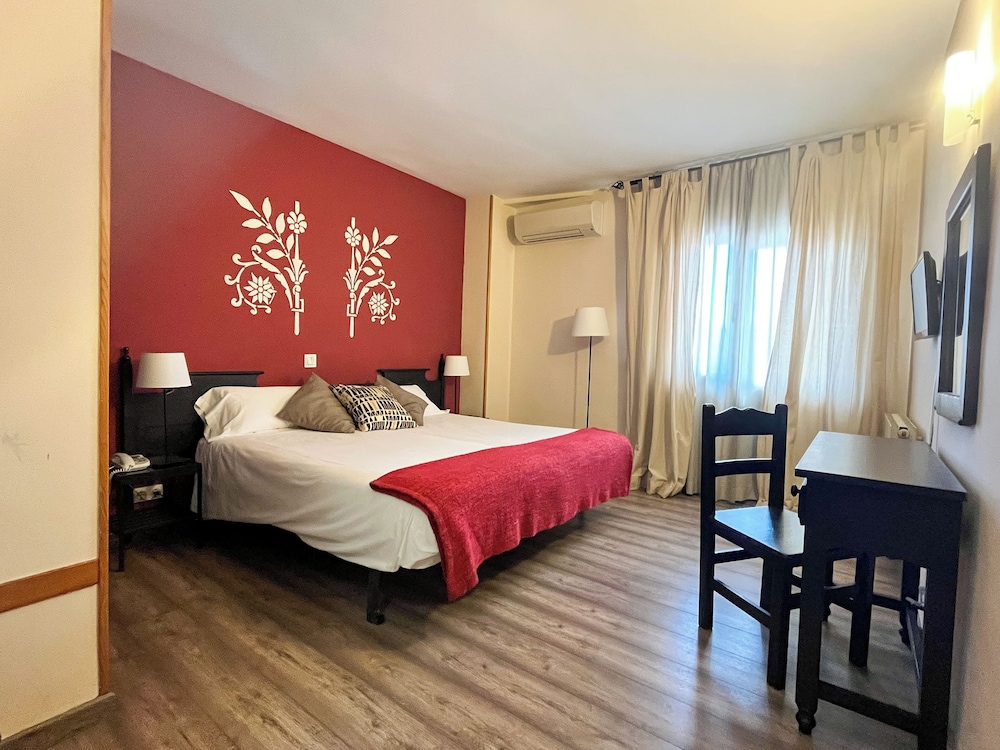
Pedraza, 37 km from the city off the N-110 beyond Torrecaballeros, is where I would send anyone whose entire brief is "log fire, stone walls, red wine". The village is walled, closed to through traffic, and its dozen small hotels are conversions of 16th and 17th-century houses that kept their chimneys. Weekend doubles run €120-190 with two-night minimums, and several properties have suites with a working fireplace in the room, wood included, which is rare elsewhere in the province. Midweek in January the same rooms drop towards €90.
The context is what makes it: Pedraza's asadores roast lamb in wood ovens, the Plaza Mayor with its wooden colonnades is floodlit and empty after dark, and there is nothing else to do, which is the point. Two warnings. Kitchens close early — plan to eat at 21:00, not 22:30. And avoid the first two Saturdays of July, when the candlelit Conciertos de las Velas fill the village and rooms are booked a year out at premium rates. A fire in July is not why you are going anyway.
2. Torrecaballeros and the N-110 corridor
The stretch of the N-110 northeast of the city, through Torrecaballeros and the villages along the foot of the sierra, is the practical fireside base: 15 minutes from Segovia, 20 from Pedraza's turn-off, with rural hotels and restored farmhouses at €90-150 that mostly have a hearth in the lounge and a car park at the door. This is also the province's asador belt, where several of the best-known roast houses sit, so you can eat extremely well within a short drive and be back beside the fire by half ten.
The trade-off is that these are working hotels rather than romantic hideaways, and on Saturdays from spring to autumn they host weddings. In deep winter that risk falls away and the same properties become cheap and quiet, which is exactly when you want them. Ask two questions when booking: is the lounge fire lit every evening or only at weekends, and is there a bedroom heating system independent of it? A hotel that lights the fire on Fridays and Saturdays only will tell you honestly if asked.
3. Valsaín, La Granja and the pine forests
Up the CL-601, La Granja and neighbouring Valsaín sit in the Sierra de Guadarrama's great pinewoods — the Pinar de Valsaín, managed for timber since the Habsburgs, is one of the most beautiful worked forests in Spain. Hotels here are simple and hiker-oriented, €70-140, and the fire is usually in a bar-lounge shared with locals, which is more fun than a private hearth. At 1,190-1,250 m this is the coldest of the easy options: snow lies here when the city has frost, and the palace gardens under snow are worth the trip on their own.
Be realistic about mobility in winter. The road over Puerto de Navacerrada at 1,858 m can require chains or close at short notice — check the road authority before relying on it — and the descent into Segovia can be icy at dawn. Book somewhere with parking you can get out of. In exchange you get the best cold-weather walking in the province: the pinewoods, the Chorranca and the marked paths above Valsaín, all starting within a few hundred metres of the hotels.
4. Sepúlveda and the Duratón
Sepúlveda, 60 km north near the A-1, offers a different winter: lower rainfall, huge skies, and a gorge that fills with mist at dawn. Hotels in tall stone houses charge €95-160 and most have a wood stove or open fire in the lounge; a few have small stoves in the top-floor rooms. The village is known nationally for roast lamb, and lunch here is a two-hour institution best followed by nothing at all. The Hoces del Duratón is at its most atmospheric in winter, though check with the park's information office on access, as some routes are restricted seasonally for nesting birds.
The catch is the gradient. Sepúlveda is stacked on a slope and the walk from the lower car parks to the Plaza Mayor is steep on stone; ice makes it worse in January. Restaurant service is heavily weighted to lunch, and on a Tuesday in February several places will be shut altogether. Call ahead. Ranked against Pedraza it is cheaper, quieter, less pretty in the square and better for walking — I would take Sepúlveda for a three-night stay and Pedraza for two.
5. Ayllón, Riaza and the ski option
The northeastern corner of the province, around Ayllón and Riaza roughly 100 and 70 km from Segovia, is the only part with a genuine ski connection: the La Pinilla station above Riaza. That makes the small hotels here — €75-130, red-stone houses with stoves and thick shutters — a legitimate winter-sports base as well as a fireside one. Opening dates and lift operations depend entirely on snow and should be checked with the station directly rather than assumed for any given week.
Even without snow, this is the best-value fire country in the province. Ayllón's arcaded Plaza Mayor and the sandstone gorges around it get a fraction of Pedraza's traffic, and prices reflect it. The compromise is distance: it is an hour and a quarter from Segovia city and closer to Madrid via the A-1 than to the Aqueduct, so it does not combine well with a Segovia sightseeing trip. Treat it as its own weekend, with the fire, the lamb and a walk in the beech and pine woods of the Sierra de Ayllón.
6. Inside Segovia's walls: manage your expectations
Old-town hotels advertise fireplaces constantly and deliver them rarely. Urban chimney flues in a dense historic centre are heavily restricted, so what you usually find is a handsome stone fireplace in the lobby that has not been lit since the 1970s, a gas or ethanol burner, or a pellet stove. None of those is a fraud, but none is a log fire either. If the fire is the reason you are booking, ask whether it burns wood, and ask for a photograph taken this winter.
The compensation inside the walls is the wood-fired ovens. Segovia's roast houses cook cochinillo in brick ovens fired with holm oak and the dining rooms are warm and smell of it — which is most of what people actually want from a fireside evening. Book the old town for the food and the empty floodlit streets, and if you want flames in your own room, drive out. That split — city for dinner, village for the fire — is how locals do a winter weekend anyway.
7. How to book so the fire is actually lit
Ask four questions by email before paying. Is the fire wood-burning? Is it lit every evening in winter or only Friday to Sunday? Is wood included, or charged per basket, which some rural hotels do at €8-15? And if there is a fireplace in the room, is there a minimum stay attached to that room type — two nights is common, three over Christmas, New Year and the December bridge. Getting written answers takes ten minutes and eliminates the single most common winter disappointment in this province.
Then pick your dates deliberately. The best value is midweek in January and February, when rural rates fall 25-35 percent and villages are genuinely empty; the worst value is the run from 27 December to 6 January, when everything is full and priced accordingly. Bring proper shoes — village streets are stone, uneven and frequently iced — and do not plan a late dinner. Order lechazo or cochinillo at nine, take the second glass to the fire at eleven, and let the room be cold; the bed will not be.
Before you book
The questions people ask about Segovia, answered with this month’s numbers.
Pedraza, 37 km from the city, for a first trip: walled, car-free at its core, a dozen small hotels in old stone houses, several with in-room fireplaces, and wood-oven roast lamb within two minutes' walk. Sepúlveda is cheaper and better for walking; Ayllón is emptiest and best value at around €75-130.
Yes, but only in a minority of rural properties, mostly in Pedraza, Sepúlveda and the sierra villages, and usually in the top room category with a two-night weekend minimum. Inside Segovia's walls it is very rare due to flue restrictions — what you find there is generally decorative, gas or pellet.
Roughly mid-November to mid-March, with the coldest stretch from late December through February, when city nights sit below freezing and the sierra villages at 1,190 m and above hold snow. Best value is midweek in January and February; the Christmas-to-Epiphany window is the busiest and most expensive of the winter.