Azoguejo Square, Segovia: The Corners Worth Knowing
 Azoguejo Square, Segovia: The Corners Worth Knowing
A practical guide to the plaza at the foot of the aqueduct — where to stand, what each side of it holds, and how to use it as a base for the old town.
Reading the Square Before You Arrive
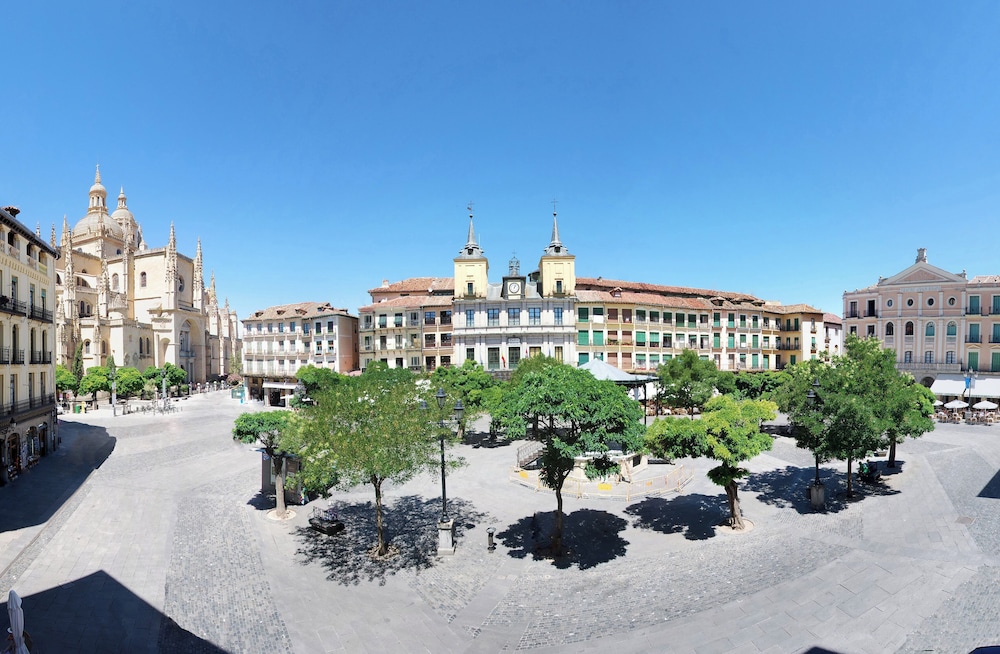
Azoguejo sits directly beneath the tallest section of the Acueducto, where the arches stack two tiers high and the pillars widen at the base. The square is not one open space but a junction: Calle Cervantes climbs north-west toward the Plaza Mayor, Calle Tejedores and the steps of the Postigo run south toward the walls, and Avenida del Acueducto opens east toward the bus stops and the road to La Granja. Arriving from the Estación de Autobuses, a fifteen-minute walk up Avenida de Vía Roma, most people meet the monument from behind, which is the wrong way round.
Come at it from Calle San Francisco or down Calle Independencia instead, and the aqueduct resolves itself slowly above the rooftops before the square opens out. Early morning, roughly seven to nine, the plaza belongs to delivery vans and dog walkers; from about ten the coach groups arrive and the central pavement becomes difficult to cross. Evening light hits the eastern face of the stone, which is the better side for photographs, and the square empties again after about nine. April to June and September to October give the best combination of light and crowd levels; August afternoons are genuinely uncomfortable under the stone.
The Four Sides and What Each One Is For
The northern edge, along Calle Cervantes, holds the practical end of things: a small tourist office kiosk in season, cafés with terrace chairs facing the arches, and the steep lane up to the Plaza del Azoguejo. Expect coffee and a tostada in the region of a few euros, menú del día at lunch in the mid-teens to low twenties in this immediate ring. The southern side is quieter, shaded by the Postigo steps and the wall walk, and has the benches. The western face, where Calle Fernández Ladreda runs down toward the Plaza de la Artillería, is where locals queue at the bakery in the morning.
The eastern side is the one people skip and shouldn't: the Centro de Recepción de Visitantes sits below the square with the aqueduct interpretation displays, and the lane behind it gives you the only view in Segovia where the arches frame the Sierra de Guadarrama. If I were booking, I'd choose a hotel within three or four minutes of the square rather than in the newer town across the valley — the difference is walking back uphill at midnight versus stepping out of a doorway. The numbered parking under the aqueduct is convenient but fills by mid-morning in summer.
Using Azoguejo as a Base
Everything in the old town is walkable from here. The Alcázar is a twenty-minute uphill walk via the Plaza Mayor and Calle Daoíz; the Cathedral, off the Plaza Mayor, is fifteen; the Jewish quarter around Calle Judería Vieja is twelve. The aqueduct itself takes twenty-five minutes to walk end to end along Calle Cervantes and Calle Real. There is a municipal bus up to the Plaza Mayor if the climb is unwelcome, and taxis wait on Avenida del Acueducto. For day trips, La Granja de San Ildefonso with its palace and fountains is about twenty minutes by car or a short bus ride from the stop near the aqueduct.
Those coming from Madrid by AVE arrive at Segovia-Guiomar, out on the plain, roughly fifteen minutes and a bus or taxi ride from Azoguejo; the slower regional trains from Chamartín stop at Segovia's older station nearer the centre. Staying in the streets immediately off the square — Calle Colón, Calle Juan Bravo, the lanes around the Plaza del Potro — puts you inside the old town without paying for a monument view. Ask for a room away from the square itself if you want quiet; the terraces stay busy until late on weekends from spring through autumn.
What to Skip and What to Do Instead
Skip the restaurants with photographs of the aqueduct on the menu boards and staff standing in the street; they cluster on the northern edge and charge for the position. Walk ten minutes to Calle del Cronista Lecea, the Plaza de la Rubia or the streets off the Plaza Mayor for lunch, where the menú del día and the cochinillo are handled with more care at a similar price. Skip the midday aqueduct climb in July and August; there is no shade, and the stone radiates heat well into the afternoon.
Do climb the Postigo steps late in the day, when the wall walk is open and the light softens, and do walk the Calle de la Judería Vieja on a weekday morning when the small museums and the old synagogue are open and quiet. The aqueduct is free to look at and free to walk under; there is no ticket, and no need for a guide to explain it. Book accommodation in advance for the weekend of the Segovia festivals and for October, when the city fills with visitors and the rooms nearest the square go first.
Before you book
The questions people ask about Segovia, answered with this month’s numbers.
Segovia-Guiomar station is about six kilometres out on the plain, roughly fifteen minutes by taxi or the connecting bus. From the bus station nearer the centre, Azoguejo is a fifteen-minute walk up Avenida de Vía Roma, or a short taxi ride.
Early morning before about nine gives empty pavement and soft light on the western face; after nine the coach groups arrive. Late afternoon and early evening light the eastern side of the stone more warmly, and the square empties again after nine in spring and autumn.
No. The aqueduct stands in the open street and can be seen and walked beneath at no cost. The Centro de Recepción de Visitantes, tucked below the square, has interpretation displays and is the place to go for context rather than a ticket queue.
Avoid the terrace restaurants with photographed menus on the square's northern edge. Walk ten minutes to the Plaza Mayor, Calle del Cronista Lecea or the Plaza de la Rubia, where lunch menus in the mid-teens to low twenties are common and the cooking is more consistent.
Yes, in about twenty minutes uphill via Calle Cervantes, the Plaza Mayor and Calle Daoíz. The Cathedral is roughly fifteen minutes away on the same route. A municipal bus runs up to the Plaza Mayor if you would rather not climb.
There is numbered underground parking beneath the aqueduct, convenient but full by mid-morning in summer. Hotels just off the square often have arrangements with nearby garages; ask when booking, since old-town streets are restricted and narrow.
La Granja de San Ildefonso, with its palace and fountains, is about twenty minutes by car or a short bus ride from the stop near the aqueduct. The walled town of Pedraza is a longer half-day option. Both are easy returns to a hotel near Azoguejo.
April to June and September to October give the best balance of light, temperature and crowd levels. July and August are hot on the exposed stone at midday, and October weekends fill the city, so book rooms near the square well ahead.